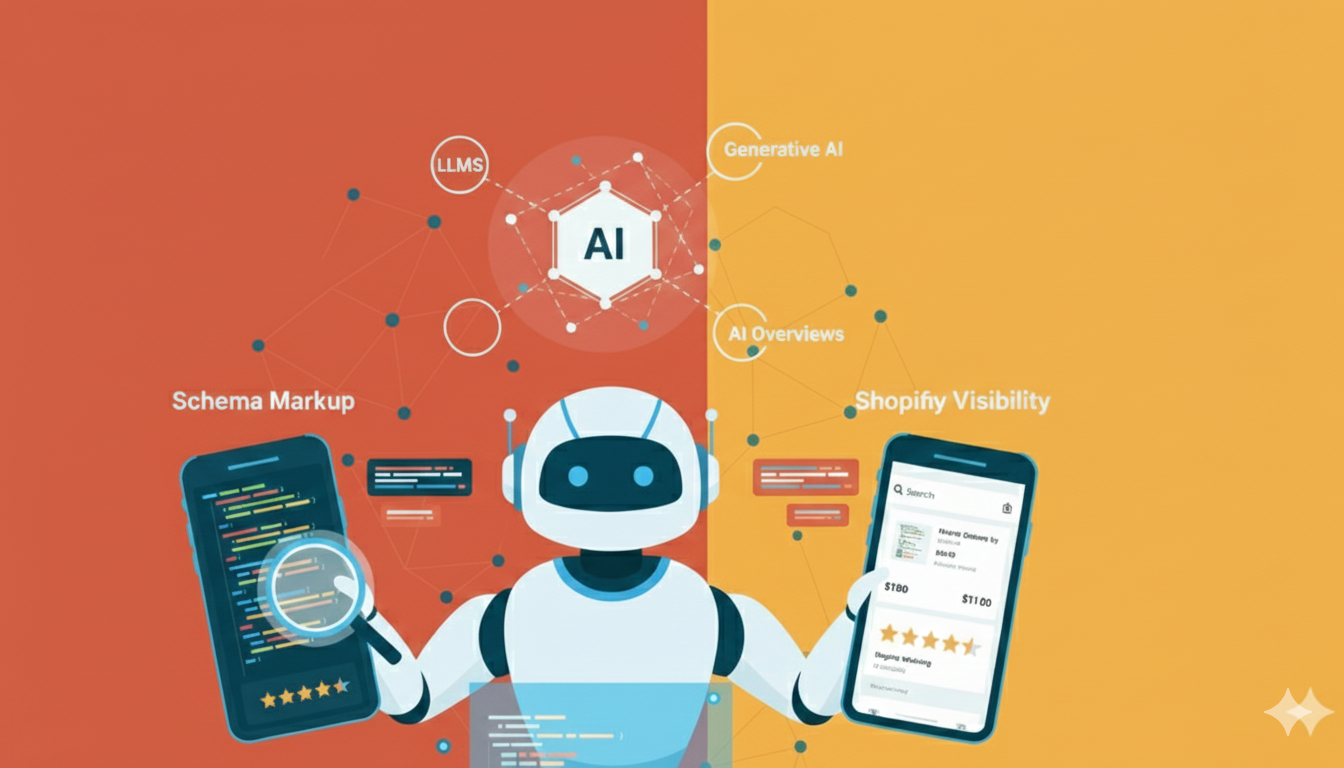
Structured data has always been a core part of SEO. It helps search engines interpret websites, create rich results, and understand products, collections, and brands. What is changing now is that Schema.org markup is no longer only a classic SEO tool. It is directly tied to how Large Language Models, AI assistants, and generative search engines understand, retrieve, and present information.
By Berker Bozdoganoglu, December 2, 2025
For Shopify merchants, this shift is significant. Schema markup is now connected not only to rankings and rich snippets, but also to how products and brands appear in AI Overviews, chat-style assistants, and other LLM-powered experiences.
In the traditional SEO world, schema has been used to provide clearer product information, FAQ content, business details, and review data. That value still exists. Rich snippets improve click-through rates, and well-structured product data helps search systems understand your catalog. Recent research shows that structured data affects AI systems in two main ways. It influences both the long-term knowledge that models learn during training and the short-term information they pull in at the moment of generating an answer. This idea is often captured under the concept of “context engineering,” which describes how structured signals, such as Schema.org markup, shape the context an AI system uses when responding.
LLMs add another layer. Structured data can become part of both:
In other words, Schema.org markup no longer just helps a crawler. It also helps the AI systems that sit on top of search and power conversational answers.
A common misconception is that LLMs directly read JSON-LD or HTML markup during pre-training in a meaningful way. In practice, the raw code is tokenized into pieces that do not preserve the structure humans see.
Instead, modern AI systems typically rely on a Data-to-Text pipeline. The process can be summarized as:
Through this process, information that originally lived in Schema.org markup becomes part of the model’s internal knowledge. The model does not “remember” the JSON-LD itself. It remembers the verbalized facts that were generated from it.
For Shopify stores, this means strong product schema, FAQ schema, and organization schema do more than support classic SEO. They also supply factual signals that can end up inside the model’s training data.
Beyond training, LLMs increasingly rely on retrieval mechanisms at runtime. These systems pull in fresh or structured information and feed it to the model as context before it generates a response. Structured data is a powerful source for this retrieval step.
This creates two complementary effects:
This combination is the essence of context engineering. By improving your structured data, you directly influence the pool of information that AI systems draw from when they answer questions about your products, your brand, or your Shopify store.
Most SEO discussions rightfully focus on JSON-LD. It is the preferred structured data format for many search systems and the dominant approach in the Shopify ecosystem. JSON-LD supports:
However, the way LLMs access a page can differ depending on the system.
In many cases:
This leads to an important insight. If an AI model is not using an index-level representation, JSON-LD may not be visible at that moment. The model mainly sees the visible HTML structure and text.
Because of this, a dual structured data strategy is increasingly useful:
For Shopify merchants, this provides an edge. Many competitors rely solely on JSON-LD. Stores that support both layers position themselves better for AI visibility in different access modes.
Many people test schema usage by asking an AI model to “read the structured data” from a specific URL. Often the model cannot see or interpret the JSON-LD in real time. This can create the false impression that structured data is being ignored.
In reality, most AI systems separate indexing and generation into two different layers:
Because the heavy structured-data work happens earlier in the indexing layer, the live model may appear blind to the schema when, in fact, it has already been influenced by it. The processing is asynchronous and not visible inside a single conversation.
The move toward AI-driven discovery is already underway. Shoppers increasingly encounter answers and recommendations inside AI experiences rather than just in traditional organic search results. Shopify merchants who rely only on classic SEO tactics risk becoming invisible in these new environments.
Clean and complete structured data now supports:
Schema is quickly becoming the structural backbone of modern e-commerce visibility.
Shopify merchants need structured data that is complete, validated, and consistently published across all product pages, collections, blogs, and FAQs. Doing this manually is time-consuming and error-prone, especially as themes change or catalogs grow.
Apps like SchemaPlus are designed to solve this problem for Shopify. They provide:
This ensures that both search engines and AI systems receive the signals they need to understand your store and surface it confidently in results.
More detailed guides, implementation tips, and AI SEO strategies are available on the SchemaPlus blog for merchants who want to go deeper.
Does structured data improve AI visibility?
Yes. Structured data influences both the information models learn during training and the information they retrieve at runtime. This increases the likelihood that AI systems will select your store or products when generating answers.
Do LLMs understand JSON-LD directly?
Not in the way humans think about reading markup. During training, structured data is typically converted into natural language sentences first. However, JSON-LD remains essential because it is the primary way many systems extract accurate facts from your site.
Should Shopify merchants use both JSON-LD and microdata?
For maximum visibility, it is beneficial. JSON-LD supports SEO, indexing, and rich results. Microdata and semantic HTML help AI agents that access the rendered page directly and rely on the visible structure.
What is context engineering in AI SEO?
Context engineering is the practice of shaping the information that AI systems use as context when generating answers. Schema.org markup is one of the most important tools for influencing that context for your brand and products.
How can I add structured data to Shopify without coding?
SchemaPlus can automatically generate and maintain complete, validated structured data for your Shopify store, improving both traditional SEO and visibility in AI-driven experiences.
Conclusion: Schema is the Structural Backbone of AI Visibility
Structured data, traditionally the domain of classic SEO for rich snippets and crawler understanding, has fundamentally evolved. It is no longer a secondary optimization; it is now the primary structural input for the generative AI systems shaping the future of search and commerce.
For Shopify merchants, this means that comprehensive Schema.org markup is the bridge connecting their product catalog and brand identity directly to Large Language Models (LLMs) and the resulting AI Overviews and conversational search experiences.